How to Get a Liquor License in Alaska (2026): Cost, Classes and Steps
How do you get a liquor license in Alaska?
In Alaska, retail liquor licenses are issued by the Alcoholic Beverage Control Board, staffed by the Alcohol and Marijuana Control Office in Anchorage. A bar needs a beverage dispensary license, a store needs a package store license and a restaurant pouring beer and wine needs a restaurant or eating place license, all issued for two-year terms. Alaska caps most retail licenses by population, so in built-up communities a first-time bar or store operator typically buys an existing license and transfers it with board approval.
In Alaska, retail liquor licenses go through the Alcoholic Beverage Control Board. A first-time applicant files with the state directly. Alaska caps the number of retail licenses, so a first-time applicant often buys an existing license and transfers it rather than obtaining a brand-new one. Work the page top to bottom and the whole path is visible before any single deadline is due.
On-premise servers must certify through the state's named training program within its window. Every owner, officer and significant investor clears a background check. A city or county sign-off is part of the path. Each piece has its own section below, with the official source beside it.
The parts a Alaska applicant most often misses are the public-notice window, which runs on the state's schedule rather than yours, the quota, which can make the license itself a far bigger cost than the state fee and the order of the steps, since several gate the ones after them. The sections below take them in order.
Which liquor license does a Alaska bar, restaurant or store need?
The retail license classes Alaska issues, what each covers and the venue each fits. Match your venue to the class before anything else.
| Class | Covers | Who it fits |
|---|---|---|
| Beverage dispensary (AS 04.09.200) Beverage dispensary license, full bar service | on-premise, full spirits | The bar and full-service class; $2,500 biennial fee; capped at one per 3,000 population, so in most established communities it is obtained by buying and transferring an existing license |
| Restaurant or eating place (AS 04.09.210) Restaurant or eating place license | on-premise, beer and wine | For food-service venues; $1,250 biennial fee; annual food receipts must at least equal alcohol receipts; capped at one per 1,500 population with a petition path for additional licenses in some cities under AS 04.11.405 |
| Package store (AS 04.09.230) Package store license | off-premise, full spirits | The retail store class; $1,500 biennial fee; capped at one per 3,000 population; the 200-foot church and school rule applies and delivery or shipping to customers each needs a separate endorsement |
| Brewery, winery or distillery retail (AS 04.09.320 to 04.09.340) Manufacturer retail licenses, taproom and tasting room | on-premise, the maker's own product as the state defines it | Taproom and tasting room classes tied to a manufacturer; capped at one of each type per 9,000 population, a cap that tightens to one per 4,500 effective January 1 2030 under AS 04.11.400 |
Is Alaska a quota or control state?
Whether Alaska caps how many licenses exist, how a capped license is obtained and whether the state runs any part of retail itself. This is where the real cost of a Alaska license can hide.
| Item | Alaska rule |
|---|---|
| Quota state? | Yes, the number of licenses is capped |
| How the cap works | AS 04.11.400 caps most retail licenses by population: one restaurant or eating place license per 1,500 residents, one brewery retail, one winery retail and one distillery retail license per 9,000 and one license of most other types, including beverage dispensary and package store, per 3,000, measured within the city or borough or within a five-mile radius outside them |
| New licenses issued by | No standing lottery. When a slot opens through population growth or a local option change, competing applications filed within a 30-day window are considered together on public interest factors and the board may hold a drawing only to break a remaining tie under 3 AAC 305.105. |
| Buying an existing license | Beverage dispensary and package store licenses trade privately and transfer with board approval; prices of $250,000 to $300,000 for full liquor licenses are market-reported in Alaska news coverage from 2019, not an official fee |
| State control | No, private licensing throughout. License state with private retail. Local option communities can restrict or prohibit sale entirely and in some local option areas the municipality itself may operate the only sales outlet under AS 04.11.505. |
How much does a liquor license cost in Alaska?
| Item | Alaska |
|---|---|
| State and local fees to apply | Roughly $1,800 to $3,100 in state fees for the main retail classes: the $500 application fee plus a biennial license fee of $1,250 to $2,500 plus fingerprint fees per person |
| Renewal | $1,550 to $2,800 per two-year cycle: the $300 renewal application fee plus the biennial license fee for the class |
| What drives the range | Class drives the range. The figures exclude any private purchase of a quota-capped license; see the quota field for the market scale. |
The itemized fees a first-time Alaska applicant can expect from the state.
| Fee | Amount |
|---|---|
| New license application fee | $500 |
| Biennial beverage dispensary license fee | $2,500 |
| Biennial restaurant or eating place license fee | $1,250 |
| Biennial package store license fee | $1,500 |
| Renewal application fee | $300 |
| Endorsement biennial fee | $200 per endorsement |
| Fingerprint processing fee | $47 per person |
| Paper filing surcharge | $150 when the online filing was available |
| Late renewal fee | $500 |
| License reinstatement fee | $1,000 |
How long it takes. 60 to 90 days after a complete application reaches the board office. AS 04.11.510 requires a board decision within 90 days of a complete application but not before the 60-day local protest window closes unless the municipality waives it. A protest, a public hearing, competing applications or pending litigation extends the clock and final action comes at a scheduled board meeting.
How to apply for a liquor license in Alaska, step by step
Several of these steps gate the ones after them, so the order matters as much as the list.
- Verify the community is not restricted under a local option election and that the premises meets zoning plus the 200-foot church and school rule where it applies
- Verify a license is available under the AS 04.11.400 population limits or line up the purchase and transfer of an existing license
- Within the 90 days before filing, post a copy of the application at the premises and one other conspicuous public location for 10 days
- Within the same window, publish the announcement once a week for three consecutive weeks in a newspaper of general circulation or arrange radio broadcasts twice a week for three weeks
- Complete Form AB-00 with all supplemental forms and file through the AK-ACCIS online system, or on paper with the $150 surcharge, with AMCO in Anchorage
- Pay the $500 application fee plus the biennial license fee and submit fingerprints with the processing fee for every required owner, officer, manager and 10 percent-or-greater holder
- AMCO sends notice to the local governing body and any village council, opening the 60-day protest period
- Respond to licensing examiner corrections until the application is deemed complete and scheduled for a board meeting
- Await the board decision, due within 90 days of the complete application, then receive the license before any sales begin
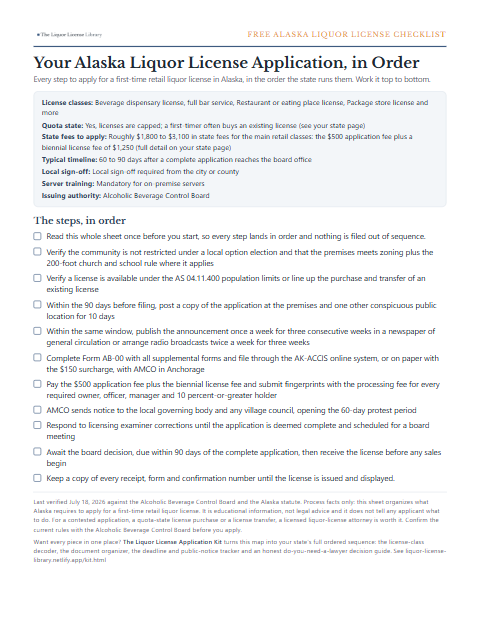
Get the free Alaska liquor license checklist
The one-page map of the Alaska application steps, in the order Alaska runs them.
Instant download, plus Alaska rule-change alerts. Unsubscribe anytime.
Local approval and public notice in Alaska
The city or county layer on top of the state license, plus any notice you must post or publish. The public-notice window is often the shortest clock in the whole process.
| Item | Alaska rule |
|---|---|
| Local sign-off required? | Yes, a city or county sign-off is part of the path |
| What the local layer does | Most communities issue no separate local liquor license. AMCO sends every application to the city, the borough and any village council, each of which can protest within 60 days; a protest forces denial unless the board finds it arbitrary, capricious or unreasonable under AS 04.11.480. Zoning compliance and the 200-foot church and school rule for beverage dispensary and package store premises run through the state application. |
| Public notice | Post a copy of the application at the premises and one other conspicuous public location for 10 days and publish a newspaper announcement once a week for three consecutive weeks, or radio announcements twice a week for three weeks, within the 90 days before filing per 3 AAC 305.075 |
| Worth knowing | Local option elections under AS 04.11.491 make many rural communities damp or dry. Permanent residents within two miles of the premises can object or petition against an application. Some municipalities layer local alcohol taxes and land-use review on top of the state process. |
Server training in Alaska
Whether the people pouring or selling alcohol must certify through a state program, plus the deadline.
| Item | Alaska rule |
|---|---|
| Required for a first-time retailer? | Yes, mandatory for on-premise servers |
| Who must certify | Licensees plus every agent and employee who sells or serves alcoholic beverages or checks patron identification |
| State program | Board-approved alcohol server education courses under AS 04.21.025 and 3 AAC 305.700; AMCO approves the course providers |
| Deadline | Within 30 days of being licensed, permitted or employed; the course card stays valid for three years |
| Worth knowing | Staff must carry the course card or a copy while selling or serving. A few manufacturer and wholesale classes are exempt from the requirement. |
Background check and renewal in Alaska
Background check
| Item | Alaska rule |
|---|---|
| Background check required? | Yes |
| Who is checked | Every proposed licensee submits fingerprints with a new application; for entities that covers each 10 percent-or-greater owner plus officers, managers and general partners. The Department of Public Safety runs a state criminal history check and may forward prints to the FBI for a national check under AS 04.11.295. |
| Disqualifiers | No automatic statutory felony bar for a new license. The board weighs a 15-year felony history, alcohol-law violations in Alaska or another state and general fitness as discretionary factors under 3 AAC 305.110, alongside mandatory denial grounds such as local option prohibition, the 200-foot location rule, zoning conflicts and false application statements under AS 04.11.320. |
| Worth knowing | Affiliates including spouses are disclosed on the application. An entity applicant must be in good standing with the state corporations division and hold a registered agent meeting AS 04.11.430. |
Renewal
| Item | Alaska rule |
|---|---|
| Renewal cycle | biennial |
| Worth knowing | Licenses run for two calendar years ending December 31, with 2026 to 2027 the current cycle. Renewal is timely by December 31, a $500 late penalty fee applies through February 28 under AS 04.11.540 and after that the license expires at midnight February 28, with reinstatement requiring board approval, good cause and a $1,000 fee. |