How to Get a Liquor License in Washington (2026): Cost, Classes and Steps
How do you get a liquor license in Washington?
In Washington, retail liquor licenses are issued by the Washington State Liquor and Cannabis Board. A first-time applicant chooses among on-premise classes such as a beer and wine restaurant or a full spirits, beer and wine restaurant and off-premise classes such as a grocery store license or a standalone spirits retailer license. Washington privatized retail liquor sales in 2012 and runs no state stores today. Only the combined spirits, beer and wine restaurant and nightclub classes carry a statewide numerical ceiling tied to population, so most first-time applicants are not entering a quota system.
In Washington, retail liquor licenses go through the Washington State Liquor and Cannabis Board. A first-time applicant files with the state directly. Washington caps only its full-spirits or specific classes, while a beer or beer-and-wine class usually sits outside the cap. Work the page top to bottom and the whole path is visible before any single deadline is due.
On-premise servers must certify through the state's named training program within its window. Every owner, officer and significant investor clears a background check. Local involvement depends on the class and the jurisdiction. Each piece has its own section below, with the official source beside it.
2SSB 5786 took effect July 27, 2025. Washington raised most retail license fees by roughly 50 percent, moving the base application fee from $75 to $112.50. It also eliminated two little-used license types. This page reflects the rule in force today; the full history sits in the law-updates log.
Which liquor license does a Washington bar, restaurant or store need?
The retail license classes Washington issues, what each covers and the venue each fits. Match your venue to the class before anything else.
| Class | Covers | Who it fits |
|---|---|---|
| Spirits, Beer, and Wine Restaurant License Full liquor restaurant or bar license | on-premise, full spirits | Common license for a full-liquor restaurant or bar serving food. Annual fee is $2,700 with less than half the floor space as dedicated dining area, $2,200 with half or more, or $1,400 for a service bar only. Shares a statewide numerical ceiling with the nightclub license class: combined issuance may not exceed one license per 1,200 of state population, a ratio well above current usage. |
| Spirits, Beer, and Wine Nightclub License Nightclub license | on-premise, full spirits | Requires entertainment and hours generally between 9pm and 2am. Shares the same statewide one-per-1,200-population ceiling as the spirits, beer and wine restaurant class. |
| Tavern License Beer and wine tavern license | on-premise, beer and wine | Fits a bar that does not serve spirits; persons under 21 are prohibited on the premises. Annual fee is $300 for beer only, $300 for wine only or $600 combined. Not part of the statewide ceiling. |
| Restaurant License, Beer/Wine Beer and wine restaurant license | on-premise, beer and wine | Common first license for a small restaurant that does not serve spirits; requires minimum food service. Not part of the statewide ceiling. |
| Grocery Store License, Beer/Wine Grocery or convenience store beer and wine license | off-premise, beer and wine | For a store selling packaged beer and wine for off-premises consumption; requires a board-set minimum food inventory. Annual fee is $550. No 10,000 square foot threshold. |
| Grocery Store License, Spirits/Beer/Wine Grocery store license with spirits privilege | off-premise, full spirits | Adds packaged spirits sales to a grocery store license. Annual fee is $2,000. |
| Spirits Retailer License Off-premise spirits retail (package store) license | off-premise, full spirits | Standalone off-premise store selling spirits in original containers. Premises generally must be at least 10,000 square feet of enclosed retail space, with exceptions for a contract liquor store location, a former state store operating-rights holder or a qualifying applicant in a trade area with no existing spirits retailer. Annual renewal fee is $550 plus a 17 percent issuance fee on spirits sales revenue billed quarterly. |
Is Washington a quota or control state?
Whether Washington caps how many licenses exist, how a capped license is obtained and whether the state runs any part of retail itself. This is where the real cost of a Washington license can hide.
| Item | Washington rule |
|---|---|
| Quota state? | Partial, the cap touches some classes only |
| How the cap works | The combined total of Spirits, Beer, and Wine Nightclub licenses and Spirits, Beer, and Wine Restaurant licenses issued statewide may not exceed one license for each 1,200 of state population, using the annual population figure from the Office of Financial Management, under RCW 66.24.420. Every other retail class (beer and wine restaurant, tavern, grocery store, spirits retailer) has no numerical cap under this statute. |
| New licenses issued by | none. Licenses in the capped classes issue administratively as applications are approved, up to the statewide ratio, rather than through a drawing. The board separately may refuse a Spirits, Beer, and Wine Restaurant license where it finds the licenses already granted in a locality are adequate for the community |
| Buying an existing license | n/a. Washington issues these licenses directly rather than as a fixed-count asset, so no established secondary market price scale is documented for these classes |
| State control | No, private licensing throughout. Washington ran a state-owned wholesale and retail spirits monopoly for decades. Initiative 1183 closed the state-run liquor stores and licensed private businesses to distribute and sell spirits, effective June 1, 2012. Both wholesale distribution and retail sale of beer, wine and spirits are handled by privately licensed businesses today; the state operates no retail stores. The 17 percent spirits retail issuance fee and the 10,000 square foot spirits retail space threshold are both artifacts of that 2012 privatization. |
How much does a liquor license cost in Washington?
| Item | Washington |
|---|---|
| State and local fees to apply | Some venue-specific on-premise classes outside this list, such as a hotel or a sports entertainment facility, run higher. A spirits retail class also pays a 17 percent issuance fee on spirits sales revenue once selling begins, billed quarterly |
| Renewal | the same class-based annual fee repeats each year, for example $550 for a Spirits Retailer or $2,200 to $2,700 for a Spirits, Beer, and Wine Restaurant, plus the ongoing 17 percent spirits issuance fee for spirits retail classes |
| What drives the range | Washington's 2025 fee increase (2SSB 5786, effective July 27, 2025) raised most liquor license, permit and endorsement fees by about 50 percent, including moving the application fee from $75 to $112.50. The figures above are the current post-increase amounts. |
The itemized fees a first-time Washington applicant can expect from the state.
| Fee | Amount |
|---|---|
| Nonrefundable application fee (new annual retail license), credited toward the license fee if approved | $112.50 |
| Spirits, Beer, and Wine Restaurant license, less than half dedicated dining area | $2,700 per year |
| Spirits, Beer, and Wine Restaurant license, half or more dedicated dining area | $2,200 per year |
| Spirits, Beer, and Wine Restaurant license, service bar only | $1,400 per year |
| Tavern license | $300 beer only or wine only, $600 combined, per year |
| Grocery Store license, Beer/Wine | $550 per year |
| Grocery Store license, Spirits/Beer/Wine | $2,000 per year |
| Spirits Retailer license annual renewal fee | $550 per year |
| Spirits retail issuance fee on sales revenue | 17 percent of spirits sales revenue, billed quarterly in arrears |
| Caterer's endorsement | $525 |
How long it takes. 60 to 90 days after a complete application. The board states this range in its own application guidance and recommends applying about 90 days before the planned opening date. A local authority objection, a location inside a designated alcohol impact area which extends local review to 60 days, or missing documents can extend the timeline beyond this range.
How to apply for a liquor license in Washington, step by step
Several of these steps gate the ones after them, so the order matters as much as the list.
- Confirm the premises clears local zoning and the 500-foot notice rule for a nearby school, church or public college or university
- Submit the liquor license application through Business Licensing Services, typically about 90 days before the planned opening date
- A Licensing Specialist is assigned and generally makes contact within about a week to conduct a phone interview about the business plan and ownership
- Submit business structure documents, financing source information, lease or purchase documentation, floor plans and a Personal/Criminal History Statement for each true party of interest
- Schedule fingerprinting for each true party of interest through the board's approved vendor for a Washington State Patrol and FBI records check
- Complete federal Alcohol Dealer Registration with the U.S. Department of the Treasury and, if the license will involve selling to other retailers, a federal Basic Permit
- The board notifies the local city or county authority, which has 20 days to respond with an approval, an objection or no response, extended to 60 days inside a designated alcohol impact area
- The board may require a public posting notice at the premises for 14 days for a new license
- Complete the retail online briefing of liquor laws and submit photos of the premises
- Pay the nonrefundable application fee, which is credited toward the annual license fee for the chosen class
- Receive the board's approval letter, which serves as a temporary license until the Master Business License with the liquor endorsement is issued
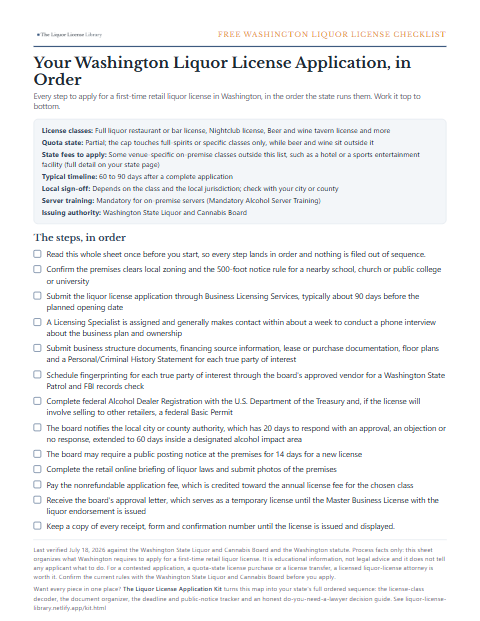
Get the free Washington liquor license checklist
The one-page map of the Washington application steps, in the order Washington runs them.
Instant download, plus Washington rule-change alerts. Unsubscribe anytime.
Local approval and public notice in Washington
The city or county layer on top of the state license, plus any notice you must post or publish. The public-notice window is often the shortest clock in the whole process.
| Item | Washington rule |
|---|---|
| Local sign-off required? | It depends on the class and the jurisdiction |
| What the local layer does | The board notifies the city, if the premises sits inside city limits, or the county legislative authority, if outside, of every new application. That local authority has 20 days to respond with an approval, an objection or no response, extended to 60 days inside a designated alcohol impact area. The board can still issue a license over a local objection. Local zoning and building approval is a separate requirement the applicant clears on its own track, not a precondition folded into the state application. |
| Public notice | conditional: the board may require a notice posted at the premises for 14 days for a new license privilege; it separately notifies a school, church or public college or university within 500 feet of the proposed premises |
| Worth knowing | This is a notice-and-objection process rather than a local licensing board vote. No evidence found of a wet or dry local-option system in Washington; the more consequential local layer is city and county zoning rather than a separate local alcohol license. |
Server training in Washington
Whether the people pouring or selling alcohol must certify through a state program, plus the deadline.
| Item | Washington rule |
|---|---|
| Required for a first-time retailer? | Yes, mandatory for on-premise servers |
| Who must certify | anyone who sells, serves, mixes or supervises the sale of alcohol for on-premises consumption at a licensed business, plus staff who pour alcohol tastings at an off-premise licensed business or fill growlers at a grocery store |
| State program | Mandatory Alcohol Server Training (MAST) under RCW 66.20.310, administered by WSLCB-certified third-party providers. A Class 12 permit issues to applicants 21 and older; a Class 13 permit issues to applicants 18 to 20, who may open, pour and carry alcohol but cannot mix drinks or draw from a tap and must work alongside a Class 12 holder. |
| Deadline | within 60 days of initial hire for servers, bartenders and managers at on-premises licensed businesses; no grace period for staff who conduct alcohol tastings |
| Worth knowing | The permit is valid for five years and is not renewable; the employee retakes the course after it expires. Selling or serving without a valid permit past the deadline is a misdemeanor. |
Background check and renewal in Washington
Background check
| Item | Washington rule |
|---|---|
| Background check required? | Yes |
| Who is checked | Every true party of interest, meaning owners, officers, partners and, for a sole proprietorship or partnership, the applicant's spouse, completes a Personal/Criminal History Statement and is fingerprinted through the board's approved vendor for a Washington State Patrol and FBI records check |
| Disqualifiers | The board scores prior convictions on a point scale: a felony conviction within 10 years scores 12 points, a gross misdemeanor within 3 years scores 5, a standard misdemeanor within 3 years scores 4, current felony supervision scores 8 with no time limit. Failing to disclose a qualifying offense adds 4 points per omission. The board will not normally issue a license to an applicant who accumulates 8 or more points, though the applicant may submit a written explanation for review. A pending case that could reach 8 or more points holds the application; the board may administratively close it if the case is not resolved within 90 days. All true parties of interest must be at least 21. |
| Worth knowing | Sole proprietor and partnership applicants, along with a spouse where applicable, must also have resided in Washington for at least 30 days before applying; this residency rule does not apply to a corporation or LLC registered with the Washington Secretary of State. Beyond the point system, a documented pattern of disregard for laws and rules, including violations at other regulatory agencies or in other states, is grounds for denial. |
Renewal
| Item | Washington rule |
|---|---|
| Renewal cycle | annual |
| Worth knowing | Each license expires at midnight on the calendar date one year after final issuance, an individual anniversary date rather than a fixed statewide date. The Department of Revenue sends a renewal notice about 45 days before expiration. The annual fee is due on or before that date to avoid a late penalty; the exact late-penalty dollar amount was not independently confirmed. |