Liquor License Cost Estimator, by State
What does a liquor license cost in your state?
A first-time retail liquor license runs from about $50 in state and local fees for a small beer license to several thousand dollars for a full-spirits class, with most first small venues in the $200 to $2,000 band. In a quota state the license itself is the real cost, because an existing one is bought privately for five or six figures. Pick your state, premise and beverage type below and the tool reads that state's own published band, its quota reality, its local layer and its timeline.
This estimator does not invent a single grand total, because an honest one does not exist before you know your exact class and your city or county add-on fees. It shows you the state's own bands and constraints so you can budget from real numbers rather than a hopeful guess.
Which California license class fits
The California retail classes that fit a bar or restaurant, across both beverage tiers. Pick a tier above to narrow it.
| Class | Covers | Who it fits |
|---|---|---|
| Type 40 On-Sale Beer | beer | Issued to bars and taverns for beer only, consumed on or off the premises. No wine or distilled spirits on the premises. Sandwiches or snacks must be available; a full meal is not required. Minors are allowed on the premises. Not a general license, so no county quota applies. |
| Type 41 On-Sale Beer and Wine, Eating Place | beer and wine | Issued to restaurants for beer and wine consumed on the premises plus beer and wine for off-premise consumption. Must operate as a bona fide eating place with suitable kitchen facilities and substantial meal sales. Minors are allowed. Not a general license, so no county quota applies; this is the common first license for a small restaurant that does not pour spirits. |
| Type 42 On-Sale Beer and Wine, Public Premises | beer and wine | Issued to bars and taverns for beer and wine consumed on or off the premises. No distilled spirits on the premises, food service not required. Minors are not allowed to enter and remain (narrow musician exception). Not a general license, so no county quota applies. |
| Type 47 On-Sale General, Eating Place | full spirits | Issued to restaurants for beer, wine and distilled spirits consumed on the premises, plus beer and wine for off-premise consumption. Must operate as a bona fide eating place with suitable kitchen facilities and substantial meal sales. Minors are allowed. A 'general' license, capped at one per 2,000 county inhabitants under Section 23816; ABC's own priority-drawing list includes Type 47 among the license types that require the drawing once a county is at or over quota. |
| Type 48 On-Sale General, Public Premises | full spirits | Issued to bars and nightclubs for beer, wine and distilled spirits consumed on the premises, plus beer and wine for off-premise consumption. Food service not required. Minors are not allowed to enter and remain (narrow musician exception). A general license subject to the same county population quota and priority drawing as Type 47. Since July 1, 2024, a new or existing Type 48 licensee must also offer drink-spiking drug test devices for sale to patrons and post the required warning sign under Business and Professions Code Section 25624. |
What a California license costs
| Item | California |
|---|---|
| State and local fees to apply | Roughly $1,135 to $2,000 in state fees for a beer-and-wine-only class such as Type 20, 40, 41 or 42 (application fee plus first-year annual fee). Roughly $20,825 to $21,385 in state fees for a full-spirits general class such as Type 21, 47 or 48 obtained through the priority drawing, not counting any private purchase price paid for an existing license on the secondary market. |
| Renewal | Roughly $500 to $1,545 per year depending on license class and, for the general on-sale classes, the population of the city where the premises sits. |
| What drives the range | The gap between the two ranges is driven entirely by license class: general (full-spirits) classes carry a much higher application fee once a priority drawing applies, while beer-and-wine-only classes do not go through the drawing. Local zoning, conditional use permit and business license fees are separate city or county charges not included in these ABC figures. Application and annual fees may be adjusted periodically under the Business and Professions Code Section 23320 inflation formula. As of this verification the live published ABC schedule is still the one effective January 1, 2022 (the figures above), while ABC's upcoming-fee pages reflect a scheduled increase for a later cycle (roughly $20,495 application for a general license and $1,170 for a non-general license, with higher annual fees), so these figures should be re-checked against the current ABC fee schedule pages each verification cycle. See the quota field for the private secondary-market price of an existing general license. |
California publishes one combined band. Where a beer-and-wine class sits inside it versus a full-spirits class is not separately published, so read the band as the range then confirm your exact class fee against the fee table.
The itemized fees a first-time California applicant can expect from the state. These are line items, not a single total; the tool never sums them.
| Fee | Amount |
|---|---|
| Application fee, general license by priority drawing (Types 21, 47, 48 and other general classes) | $19,840 |
| Application fee, non-general license (Types 20, 40, 41, 42 and most others) | $1,135 |
| Priority drawing participation fee | Equal to the general license application fee, refunded less a $100 service charge if the participant does not go on to file a formal application |
| Annual license fee, Type 20 (Off-Sale Beer and Wine) | $500 |
| Annual license fee, Type 21 (Off-Sale General) | $1,009 |
| Annual license fee, Type 40 (On-Sale Beer) | $500 |
| Annual license fee, Type 41 (On-Sale Beer and Wine Eating Place) | $565 |
| Annual license fee, Type 42 (On-Sale Beer and Wine Public Premises) | $705 |
| Annual license fee, Type 47 and Type 48 (On-Sale General) | $985 to $1,545 depending on the population of the city where the premises sits |
| Fingerprinting fee | $63 |
| Temporary permit (per license type, except Type 58) | $100 |
| Interim operating permit | $180 |
The quota reality in California
Quota state? Partial. California caps some classes only, most often the full-spirits or general class.
How the cap works. General (full-spirits) license classes are capped by county population: on-sale general classes such as Type 47 and 48 are limited to one license per 2,000 county inhabitants under Business and Professions Code Section 23816 while off-sale general Type 21 is limited to one per 2,500 inhabitants under Section 23817. New original general licenses become available mainly as county population grows. Beer-and-wine-only classes (Type 20, 40, 41, 42) are not general licenses and are not counted against this cap.
New licenses issued by. When a county already holds as many general licenses as its population ratio allows, ABC opens an annual statewide filing window for the counties and license types that are over the ratio (most recently September 8 to 19, 2025) and holds a virtual drawing in the following weeks to set priority order among applicants. A participant must have been a California resident for at least 90 days before the drawing and pays a participation fee equal to the general license application fee, refunded less a $100 service charge if no formal application follows. A county that is still under its population ratio does not require a drawing and a general license there can be applied for directly.
Buying an existing license. In a county where the general license quota is full, an existing Type 47 or Type 48 license can be purchased from a current holder and transferred instead of applying for a new one; the full purchase price is placed in escrow before the transfer application is filed and a notice of intended transfer is recorded with the county recorder. Prices themselves are market-reported by license brokers, typically well into five figures in lower-demand counties and commonly $100,000 to $400,000 or more in high-demand counties such as Los Angeles and San Francisco. These figures are market-reported, not an official ABC fee.
This cap falls on the full-spirits or general classes. A beer-and-wine class in California usually sits outside it, so switching the beverage tier above changes this answer.
Local approval and public notice
The city or county layer on top of the state license, plus any notice you must post or publish. The public-notice window is often the shortest clock in the whole process.
| Item | California rule |
|---|---|
| Local sign-off required? | It depends on the class and the jurisdiction |
| What the local layer does | No retail license may be issued for premises where the use is contrary to a valid local zoning ordinance (Business and Professions Code Section 23790); most cities and counties require a zoning clearance or a conditional use permit before ABC will complete the application. ABC also mails a copy of every application to local police or the sheriff, the district attorney, the planning department and the city council or board of supervisors, who may request conditions or file a protest (Section 23987). ABC may refuse a license within roughly 600 feet of a school or public playground and in the immediate vicinity of a church or hospital (Section 23789). |
| Public notice | The applicant must post a Public Notice of Application at the premises for at least 30 consecutive days (Section 23985). In some cases ABC also requires newspaper publication or, where the local jurisdiction provides address data free of charge, mailed notice to residents and property owners within a 500-foot radius (Section 23985.5). Protests may be filed within 30 days of whichever notice event happens last (Section 24013). |
| Worth knowing | Zoning and conditional use permit approval is typically pursued locally in parallel with the state application, often starting first, since ABC generally holds the application until zoning compliance is confirmed. If a local governing body finds the premises would add to crime or sits in an already over-concentrated area, it has 90 days to notify ABC of that finding before ABC can proceed on its own public-convenience-and-necessity determination. |
The timeline in California
How long it takes. A minimum of 30 days by law, with most ABC investigations taking approximately 55 to 65 days from a complete application. ABC's own guidance states most investigations take roughly 55 to 65 days and that the license cannot be issued for a minimum of 30 days after the required notices go out; a local protest, an incomplete application, or a general-license county quota can extend this well beyond that range. A general license in an over-quota county adds the annual priority filing window and drawing period before the standard investigation timeline even begins.
Email me my California cost summary
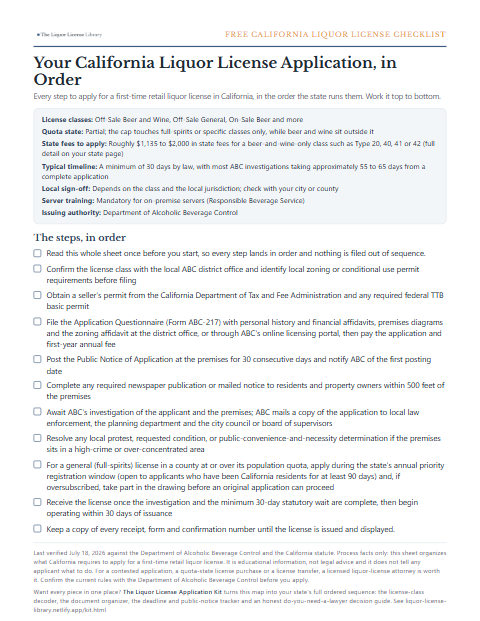
Get this summary as a one-page map, plus the free state application checklist for the state you picked.
Instant summary, plus rule-change alerts for your state. Unsubscribe anytime.
This tool shows you the bands and the constraints. The Liquor License Application Kit fills them in for your California application. The done pieces for your state: the license-class decoder, the dependency-ordered filing checklist, the document-gathering organizer, the deadline and public-notice tracker and an honest do-you-need-a-lawyer decision guide. The reference stays free; the kit is the evening of assembly you skip.
Liquor license cost estimator FAQ
How much does a liquor license cost?
It depends on your state and the license class. State and local fees run from about $50 for a small beer license to several thousand dollars for a full-spirits class. Most first small venues land in the $200 to $2,000 band. In a quota state the license itself is the real cost, because an existing one trades privately for five or six figures. Pick your state above for its own published band.
How do I tell if my state is a quota state?
Choose your state and the full-spirits tier above. A quota state caps how many licenses can exist, so a full-spirits license there is often bought from an existing holder and transferred rather than issued new. The tool reads each state's own status: thirteen states run a hard quota, sixteen more cap only certain classes and the rest set no cap.
Do I need a full liquor license to serve beer and wine?
Usually no. Most states issue a separate beer-and-wine class that costs less and, in a quota state, normally sits outside the cap, so it can be applied for directly. Select the beer-and-wine tier above to see the classes your state offers and where they sit inside the fee band.
Does this tool give me an exact total?
No. No honest tool can, because the final number turns on your exact class, your city or county add-on fees and, in a capped county, a private purchase price the state does not set. The estimator shows the state's own published fee band, the quota reality and the timeline. The kit fills in the exact class and every document for your state.
Where do these numbers come from?
Each state's fee band, quota status, local-approval layer and timeline are read from that state's own statute and alcohol authority, then dated on the state page. Where a state does not publish a figure the tool says so at that line rather than guessing.
How this estimator works
Every figure here is read from the state's own facts on that state's page, run against its statute and alcohol authority and dated. The tool filters and reveals; it never fetches and it never sums the line items into a false grand total. Where a state does not publish a number, the tool says so at the exact line rather than guessing. For the full rules behind any state, open its page from the directory, or read the cost-by-state guide, the quota guide and the control-states guide.
This estimator is educational information, not legal advice and it does not tell any applicant what to do. It does not come from a state alcohol agency. Fees, quotas and timelines change; confirm the current figures with your state before you rely on them. For a contested application, a quota-state license purchase or a license transfer, talk to a licensed liquor-license attorney.