How to Get a Liquor License in Oregon (2026): Cost, Classes and Steps
How do you get a liquor license in Oregon?
In Oregon, retail liquor licenses are issued by the Oregon Liquor and Cannabis Commission through the online CAMP portal. OLCC issues a Full On-Premises Sales license to a restaurant or bar serving spirits by the drink, a Limited On-Premises Sales license to a beer and wine only venue and an Off-Premises Sales license to a store selling packaged beer, wine and cider. Oregon sets no population-based quota on any of these classes and every applicant must first secure a local government recommendation before OLCC will consider the application.
In Oregon, retail liquor licenses go through the Oregon Liquor and Cannabis Commission. A first-time applicant files with the state directly. Oregon sets no cap on the number of retail licenses, so there is no slot to wait for and no existing license to buy out. Work the page top to bottom and the whole path is visible before any single deadline is due.
Oregon runs a partial control system, handling some spirits wholesale or retail itself while private retailers hold the on-premise and off-premise licenses. On-premise servers must certify through the state's named training program within its window. Every owner, officer and significant investor clears a background check. Each piece has its own section below, with the official source beside it.
HB 4138 took effect March 31, 2025. Oregon closed the 45-day provisional window that let a new server work before finishing service-permit training, so every step of that training must now finish before a new hire serves. This page reflects the rule in force today; the full history sits in the law-updates log.
Which liquor license does a Oregon bar, restaurant or store need?
The retail license classes Oregon issues, what each covers and the venue each fits. Match your venue to the class before anything else.
| Class | Covers | Who it fits |
|---|---|---|
| F-COM (Full On-Premises Sales, Commercial) Full on-premises sales, commercial | on-premise, full spirits | Fits a restaurant or bar serving spirits, beer, wine and cider by the drink. No population quota. Must keep at least five different meals available and 30 dining seats during the two hours before 10pm unless the Commission finds food service clearly dominant. |
| Limited On-Premises Sales Limited on-premises sales | on-premise, beer and wine | Fits a beer and wine bar or restaurant that does not serve spirits, also covers cider. No food service requirement and no population quota. Annual fee is lower than the full spirits class. |
| Off-Premises Sales Off-premises sales | off-premise, beer and wine | Fits a grocery, convenience or bottle shop selling packaged beer, wine and cider for takeout. Does not cover packaged spirits, which OLCC sells only through its own contracted retail sales agent locations, a separate appointment process outside standard OLCC retail licensing. |
Is Oregon a quota or control state?
Whether Oregon caps the number of licenses and whether the state runs any part of retail itself. Oregon sets no cap, though its control structure still shapes which license a private business can hold.
| Item | Oregon rule |
|---|---|
| Quota state? | No, there is no cap on the number of licenses |
| State control | Partial control. OLCC controls the wholesale and retail distribution of distilled spirits statewide, owning the inventory sold through more than 280 contracted retail sales agent locations. Beer, wine and cider are privately distributed and sold under standard OLCC retail licenses. A private off-premise retail applicant can sell beer, wine and cider but cannot obtain a standard license to sell packaged spirits. |
How much does a liquor license cost in Oregon?
| Item | Oregon |
|---|---|
| State and local fees to apply | roughly $300 to $1,200 in combined state and local costs for a first-time retail applicant, before the cost of liquor liability insurance |
| Renewal | $200 to $800 per year in state license fees depending on class, plus any local renewal processing fee |
| What drives the range | Driven mainly by license class ($200 off-premise up to $800 full on-premise), the number of owners or officers requiring the $50 fingerprint check, per-person $23 service permit fees and a local government processing fee that varies by city or county with no statewide standard. |
The itemized fees a first-time Oregon applicant can expect from the state.
| Fee | Amount |
|---|---|
| Full On-Premises Sales license (Commercial, Caterer, For-Profit Private Club, Other Public Location, Public Passenger Carrier) | $800 annually |
| Full On-Premises Sales, Nonprofit Private Club | $400 annually |
| Limited On-Premises Sales license | $400 annually |
| Off-Premises Sales license | $200 annually |
| Alcohol service permit, per required permit holder | $23.00 non-refundable |
| Fingerprint-based background check, per owner, officer or LLC manager required on the application | $50 per person |
| Local government application and processing fee | varies by city or county; ORS 471.166 caps the local application fee at $25 and the processing fee at $100 for an original application, so up to about $125 in local fees for a new outlet |
How long it takes. roughly 2 to 4 months from a complete application to a license decision. OLCC investigations typically take 4 to 8 weeks once a complete application is submitted. This follows the local government recommendation step, which ORS 471.166 allows local governments up to 45 days to file after notice, though many jurisdictions respond sooner. Delays extend the timeline when the location has prior OLCC or police problems, the applicant has a criminal history, has given false information or has a history of substance abuse.
How to apply for a liquor license in Oregon, step by step
Several of these steps gate the ones after them, so the order matters as much as the list.
- Choose the license class that matches the business: Full On-Premises Sales for a restaurant or bar serving spirits, Limited On-Premises Sales for a beer and wine only bar or restaurant, or Off-Premises Sales for a beer, wine and cider store
- Confirm the Oregon business address is owned, leased, rented or in the process of being acquired
- Register the business entity with the Oregon Secretary of State if operating as a corporation or LLC
- Obtain the Local Government Recommendation Form from the city or county and submit it before applying to OLCC
- Read the Law Orientation for Retailers document and submit the Law Orientation Affirmation
- Complete an approved Alcohol Server Education course and pass the OLCC-proctored exam for every required permit holder
- Secure at least $300,000 of liquor liability insurance naming OLCC as certificate holder
- Submit the application through the CAMP online portal with fingerprint-based background check submissions for owners, officers or LLC managers
- Pay the OLCC license fee for the chosen class and any local government processing fee
- Undergo the OLCC investigation, including the criminal history check and a site review
- Receive the local government's recommendation, which state law allows up to 45 days to file after notice is given
- Receive the OLCC decision and download the license through CAMP before selling
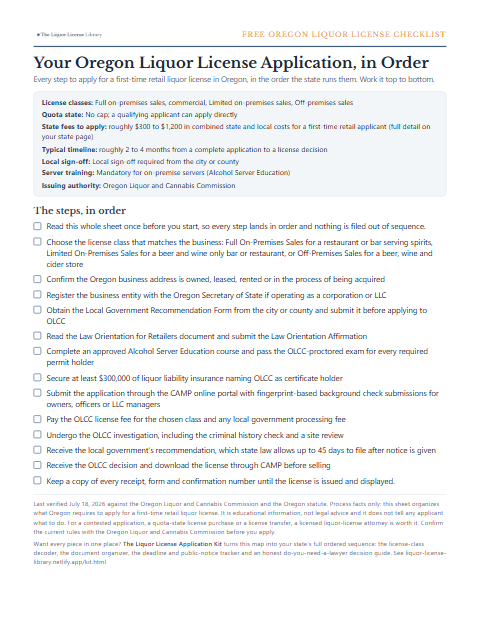
Get the free Oregon liquor license checklist
The one-page map of the Oregon application steps, in the order Oregon runs them.
Instant download, plus Oregon rule-change alerts. Unsubscribe anytime.
Local approval and public notice in Oregon
The city or county layer on top of the state license, plus any notice you must post or publish. The public-notice window is often the shortest clock in the whole process.
| Item | Oregon rule |
|---|---|
| Local sign-off required? | Yes, a city or county sign-off is part of the path |
| What the local layer does | The city council, or the county governing body if the premises sits outside an incorporated city, reviews the application and can recommend approval, denial or conditions. OLCC requires this Local Government Recommendation Form before an application is considered complete. |
| Public notice | Varies by city or county. Portland posts new applications online for a roughly 30-day public comment period and Beaverton posts for 7 days. OLCC itself sets no single statewide public notice window; each local government runs its own notice process within the ORS 471.166 recommendation step. |
| Worth knowing | The local recommendation step comes before the OLCC application is submitted. Local governments may also charge their own processing fee separate from the OLCC license fee. |
Server training in Oregon
Whether the people pouring or selling alcohol must certify through a state program, plus the deadline.
| Item | Oregon rule |
|---|---|
| Required for a first-time retailer? | Yes, mandatory for on-premise servers |
| Who must certify | Anyone who mixes, serves or sells alcoholic beverages at a licensed premises allowing on-premises consumption; any manager who supervises that service; and off-premises employees who fill growlers for take-out |
| State program | Alcohol Server Education, an OLCC-approved course followed by an OLCC-proctored exam, required for the Alcohol Service Permit |
| Deadline | Since March 31 2025, all steps (application, payment, the course and the proctored exam) must be completed before mixing, selling or serving alcohol. The permit is valid five years. |
| Worth knowing | House Bill 4138 (2024) eliminated the prior 45-day provisional serving window that let a new hire serve while still completing training. Every on-premises licensee must now personally hold a service permit or designate a permit holder with authority over alcohol service. |
Background check and renewal in Oregon
Background check
| Item | Oregon rule |
|---|---|
| Background check required? | Yes |
| Who is checked | Owners, corporate officers, LLC managers and any other individual or entity entitled to exercise control over the business, incur its debts or enter contracts on its behalf must each complete an OLCC Individual History form and a fingerprint-based criminal history check through Oregon State Police and the FBI. |
| Disqualifiers | ORS 471.313 lets OLCC refuse a license for statutory grounds including habitual excess use of alcohol or controlled substances, false statements to the Commission, a relevant criminal conviction, not being of good repute and moral character, an inability to read, write or understand Oregon's liquor laws, unsanitary premises or concealed ownership interests. These are evaluated case by case rather than under a fixed conviction lookback window. |
| Worth knowing | Fingerprinting is scheduled through IdentoGO at a corroborated cost of $50 per person. |
Renewal
| Item | Oregon rule |
|---|---|
| Renewal cycle | annual |
| Worth knowing | Oregon splits the state into four renewal districts with staggered expiration dates of December 31, March 31, June 30 and September 30 rather than one statewide date. CAMP opens the renewal application 75 days before expiration and the online renewal must be submitted at least 20 days before expiration to avoid a late fee. Local governments have 60 days to recommend on a renewal, with a possible 45-day extension if considering an unfavorable recommendation. |