How to Get a Liquor License in Idaho (2026): Cost, Classes and Steps
How do you get a liquor license in Idaho?
In Idaho, retail alcohol licenses are issued by the Alcohol Beverage Control bureau of the Idaho State Police, with separate state licenses for beer, wine and liquor by the drink plus city and county licenses layered on top. Beer and wine licenses issue on application, while on-premise liquor by the drink is quota limited to one license per 1,500 city residents with a priority waiting list in built-out cities. Idaho is also a control state for spirits, so there is no private package store license and bottled liquor sells only through state and contracted liquor stores.
In Idaho, retail liquor licenses go through the Alcohol Beverage Control, Idaho State Police. A first-time applicant files with the state directly. Idaho caps the number of retail licenses, so a first-time applicant often buys an existing license and transfers it rather than obtaining a brand-new one. Work the page top to bottom and the whole path is visible before any single deadline is due.
Idaho is a control state, so a private applicant cannot open a full-spirits package store; spirits move through state stores and the private retail license covers beer, wine or on-premise service. The state sets no server-training requirement. Every owner, officer and significant investor clears a background check. Each piece has its own section below, with the official source beside it.
The parts a Idaho applicant most often misses are the public-notice window, which runs on the state's schedule rather than yours, the quota, which can make the license itself a far bigger cost than the state fee and the order of the steps, since several gate the ones after them. The sections below take them in order.
Which liquor license does a Idaho bar, restaurant or store need?
The retail license classes Idaho issues, what each covers and the venue each fits. Match your venue to the class before anything else.
| Class | Covers | Who it fits |
|---|---|---|
| Liquor by the drink (incorporated city quota license) Retail liquor by the drink license | on-premise, full spirits | The quota class for bars and full-service restaurants inside city limits, capped at one license per 1,500 city residents. The holder must also hold a retail beer license and typically adds the wine classes. Licenses issued on or after July 1, 2023 are tied to the premises and are not transferable. |
| Specialty liquor by the drink Specialty liquor licenses for statutorily qualified premises | on-premise, full spirits | Non-quota licenses for premises that meet a statutory definition: golf course, ski resort, equestrian facility, airport restaurant, convention center, resort city conference and event center, year-round resort, tribal facility and, effective July 1, 2026, a bona fide distillery selling its own brands. Most are premises-bound and not transferable. The 75-year continuous-operation class ends for new issues after July 1, 2028. |
| Retail beer license Retail beer license | both, beer | The base retail class for stores and taprooms at $50 per year. Bottled and canned beer to go is the default; an on-premises consumption endorsement for draft and in-house service carries no additional state fee. A keg-to-go endorsement is $20 per year. |
| Wine by the bottle Retail wine license, off-premises consumption | off-premise, table and dessert wine | The package class for grocery, convenience and bottle shops at $100 per year. Wine retail sits under the County Option Kitchen and Table Wine Act, so it depends on the county remaining wet for wine. |
| Wine by the drink Wine by the drink license, on-premises consumption | on-premise, table and dessert wine | The by-the-glass wine class for restaurants and wine bars at $100 per year. A common first pairing with the retail beer license for a restaurant that does not serve spirits. |
Is Idaho a quota or control state?
Whether Idaho caps how many licenses exist, how a capped license is obtained and whether the state runs any part of retail itself. This is where the real cost of a Idaho license can hide.
| Item | Idaho rule |
|---|---|
| Quota state? | Yes, the number of licenses is capped |
| How the cap works | One liquor by the drink license per 1,500 residents of an incorporated city or fraction thereof, with at least two licenses available to cities of 1,500 or fewer. Population counts use the census, a special census or a statistically valid estimate that can include new residential utility connections and annexed areas. Quota licenses issue only inside city limits; specialty classes for qualifying premises sit outside the quota. |
| New licenses issued by | None. ABC maintains a priority waiting list per city. Joining costs a deposit of half that city's annual license fee and new licenses are offered once a year, about late July or early August, in list order as population growth or surrendered and revoked licenses create openings. |
| Buying an existing license | Licenses issued before July 1, 2023 are legacy licenses that may be sold one final time with ABC approval, subject to the 10 percent state transfer fee. Ada County legacy licenses were trading around $300,000 to $500,000 in 2023, a market-reported figure and not an official fee. Licenses issued on or after July 1, 2023 are tied to the premises and cannot be sold. |
| State control | Yes, a control state. Idaho controls distilled spirits at the distribution and off-premise retail level. Bottled liquor is sold only through state-operated liquor stores and ISLD-authorized contract stores, so no private off-premise spirits license exists. Bars and restaurants must buy their liquor from state retail stores. Beer and wine move through private licensed wholesalers and distributors. |
How much does a liquor license cost in Idaho?
| Item | Idaho |
|---|---|
| State and local fees to apply | Roughly $100 to $1,500 in combined state and local fees depending on class and city, plus $37 per fingerprinted person. A beer and wine store runs near the bottom of that range; a liquor by the drink bar in a city over 3,000 residents pays $750 to the state plus up to $750 more across the city and county licenses. |
| Renewal | The same annual fees recur: $50 beer, $100 per wine class and $300 to $750 for liquor by the drink, plus the local license renewals. |
| What drives the range | The state fee for liquor by the drink scales with city population. State and local fees exclude any private purchase of a legacy quota license; see the quota field for that market. |
The itemized fees a first-time Idaho applicant can expect from the state.
| Fee | Amount |
|---|---|
| Liquor by the drink annual license fee, city of 1,000 or fewer residents | $300 |
| Liquor by the drink annual license fee, city of 1,000 to 3,000 residents | $500 |
| Liquor by the drink annual license fee, city over 3,000 residents | $750 |
| Priority waiting list deposit | Half the annual license fee for the chosen city, for example $375 for Boise |
| Retail beer license, annual | $50 |
| Wine by the bottle license, annual | $100 |
| Wine by the drink license, annual | $100 |
| Keg-to-go license, annual | $20 |
| Fingerprint background check, per person on an initial application | $37 |
| City liquor by the drink license | Up to 75 percent of the state fee, set by each city |
| County liquor by the drink license | Up to 25 percent of the state fee, set by each county |
| County and city beer licenses | County up to $100 and city up to $200 for on-premises; 25 percent of those caps for off-premises only |
| County and city wine licenses | County up to $100 and city up to $200 |
| Legacy license transfer fee | 10 percent of the purchase price or the value of goodwill, whichever is greater |
How long it takes. Up to 90 days of ABC investigation after a complete application, where a license is available. Idaho Code 23-907 gives ABC up to 90 days to investigate and the FAQ confirms actual time varies with workload, processed first come first served. The premises inspection is scheduled near completion of construction. In quota cities with no license available the real timeline is the priority waiting list, which moves only with annual population-driven offers. City and county licensing adds local processing time.
How to apply for a liquor license in Idaho, step by step
Several of these steps gate the ones after them, so the order matters as much as the list.
- Confirm the premises sits inside incorporated city limits for a quota liquor license or matches a specialty class definition. Also confirm it meets the 300-foot church and school distance rule unless the local government waives it
- For a quota license in a city at its cap, submit the Priority Waiting List Application with a deposit of half the annual license fee for that city and keep the mailing address current; offers go out about late July or early August each year in list order
- Complete the ABC application for the class: the Liquor License Application or the Beer and Wine Application, accompanied by the annual license fee
- Submit a full set of fingerprints and the $37 background check fee for every person listed on an initial application
- Cooperate with the ABC investigation, allowed up to 90 days under Idaho Code 23-907, including the premises inspection scheduled by an ISP detective near opening
- Obtain the required county and city licenses after state approval; for beer the statute directs ABC approval first, then city or county issuance
- Display the signed original state, city and county licenses at the premises before selling, serving or dispensing alcohol
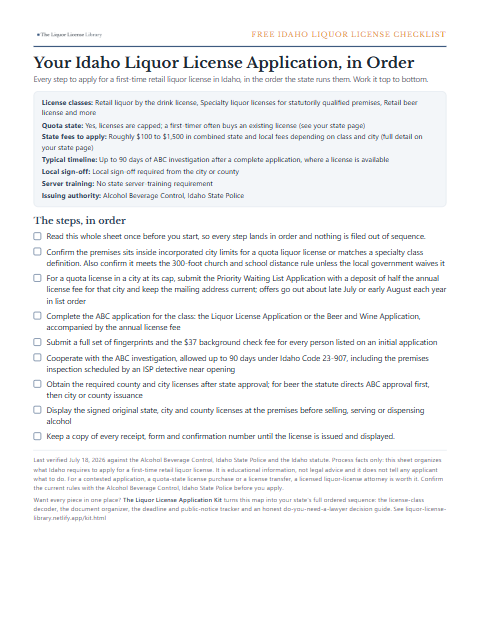
Get the free Idaho liquor license checklist
The one-page map of the Idaho application steps, in the order Idaho runs them.
Instant download, plus Idaho rule-change alerts. Unsubscribe anytime.
Local approval and public notice in Idaho
The city or county layer on top of the state license, plus any notice you must post or publish. The public-notice window is often the shortest clock in the whole process.
| Item | Idaho rule |
|---|---|
| Local sign-off required? | Yes, a city or county sign-off is part of the path |
| What the local layer does | Each premises also needs its county and city alcohol licenses. Cities may charge up to 75 percent and counties up to 25 percent of the state liquor fee, with parallel capped fees for beer and wine. They may also layer their own regulations, hours and training ordinances on the state license. The 300-foot distance rule between an on-premises entrance and a church or school property line applies statewide, with a city or county waiver possible. |
| Public notice | No statewide newspaper publication or premises posting requirement appears in the retail licensing statutes; any hearing or notice step comes from local ordinance |
| Worth knowing | Filing runs state first, then local issuance. Local option exists on two layers: cities can vote to disapprove liquor by the drink under Idaho Code 23-917 through 23-921 and retail wine depends on the county option under the Kitchen and Table Wine Act. County beer and wine license decisions follow ordinance-set procedures with written reasons on denial and judicial review available. |
Server training in Idaho
Whether the people pouring or selling alcohol must certify through a state program, plus the deadline.
| Item | Idaho rule |
|---|---|
| Required for a first-time retailer? | No state server-training requirement |
| State program | Idaho sets no state server certification. Idaho State Police ABC offers free voluntary seller and server training sessions announced on the ABC site. |
| Worth knowing | The ABC FAQ states Idaho does not require alcohol servers to hold formal training or certification, while some cities and counties mandate training such as TIPS by local ordinance. Licensees in those jurisdictions must use locally approved programs, so the practical rule is set at city and county level. |
Background check and renewal in Idaho
Background check
| Item | Idaho rule |
|---|---|
| Background check required? | Yes |
| Who is checked | Every person listed on an initial application submits a full set of fingerprints with the $37 fee for an Idaho state and FBI criminal history check. Partnerships list all partners; corporations and LLCs list officers, directors and the ten principal stockholders or members. ABC may also examine books, records, bank accounts and tax returns of anyone with a financial interest. |
| Disqualifiers | A conviction under any alcohol beverage law within 3 years of applying, or any felony within 5 years measured from completing the sentence, probation or fine, including withheld judgments, disqualifies an applicant. So do prostitution-related operations, morality-clause convictions, a revoked alcohol license within the lookback and supplier-tier interests such as a distillery, brewery, winery or wholesaler, except licensed distilleries from July 2026. A liquor by the drink applicant must hold an Idaho retail beer license. Idaho residency is not required. A misdemeanor DUI does not disqualify. |
| Worth knowing | An ISP detective inspects the building before issuance. Fingerprints on file within 3 years can sometimes be reused for the same license type but a step up from beer and wine to liquor always requires new prints. The $37 is the Idaho State Police national (state plus FBI) criminal history check fee for licensure applicants, confirmed current as of July 2026; a separate state-only fingerprint check rose from $20 to $25 under the ISP fee schedule effective January 1, 2026 but ABC licensing requires the full national check. |
Renewal
| Item | Idaho rule |
|---|---|
| Renewal cycle | annual |
| Worth knowing | Renewal months are assigned by county under administrative rule to spread renewals through the year. ABC mails renewal applications about 8 weeks before expiration. A 31-day grace period follows expiration but no alcohol may be sold during it and a license not renewed within the grace period is lost permanently. |